Zakat, an Arabic word meaning 'purification' or 'growth,' is a pillar of Islam, an obligatory annual contribution made to the poor and needy. It's more than just a donation; it's a spiritual cleanser for your wealth, reminding us that all sustenance comes from Allah and should be shared with those less fortunate.
Paying Zakat purifies the remainder of your wealth and brings immense blessings. It fosters compassion, social justice, and economic balance within the Muslim community and beyond. Every Zakat contribution provides essential relief, transforms lives, and offers hope to families struggling with poverty, hunger, and lack of basic necessities.
"“And establish prayer and give Zakat, and whatever good you send ahead for yourselves - you will find it with Allah. Indeed, Allah, of what you do, is Seeing.”"
Calculating Zakat can seem complex, but our easy-to-use Zakat Calculator simplifies the process. It guides
you through assessing your assets and liabilities to determine your precise Zakat obligation.
Use the Zakat Calculator to ensure your Zakat is accurate and complete.
Gold Nisab
Silver Nisab
Note: Nisab values are approximate and subject to daily market fluctuations. Please verify current rates when calculating.
Include cash savings, gold and silver, business stock, investments, rental income and any money owed to you.
Deduct any short-term debts that are due within the next lunar year. Do not include long-term debts such as mortgages on your primary residence.
Subtract your total liabilities from your total assets to determine your net Zakatable wealth.
If your net wealth exceeds the Nisab threshold, Zakat becomes obligatory upon you.
Multiply your net Zakatable wealth by 2.5% (0.025). This is the amount of Zakat you must pay.
Business owners must include stock, inventory, cash in business accounts, profits and money owed to the business when calculating Zakat.
The current market value of all saleable stock and inventory should be included in your Zakat calculation at the end of your Zakat year.
Zakat is due on retained profits, liquid capital and receivables. Any outstanding debts owed to your business that are likely to be repaid should also be included.
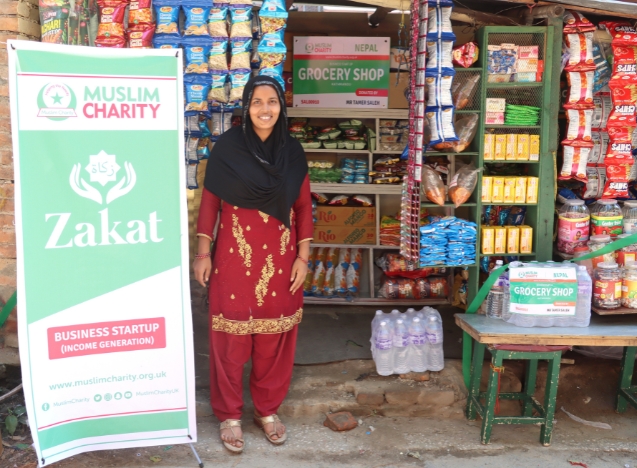
A New Beginning for Someone in Need
Our 'Zakat for Start-ups' program empowers vulnerable individuals
with the tools and resources to establish small businesses,
fostering self-sufficiency and breaking cycles of poverty. Your
Zakat contribution directly fuels these life-changing initiatives.
Muslim Charity ensures your Zakat reaches those most deserving
according to Islamic principles. We meticulously identify
beneficiaries and deliver aid efficiently, transparently, and
with dignity.
"Indeed, [prescribed] charitable donations are only for the poor, and the needy, and those employed to collect [zakat], and those whose hearts are to be reconciled, and for [freeing] captives, and for those in debt, and for the cause of Allah , and for the wayfarer; [as] an obligation from Allah . And Allah is Knowing and Wise."
Giving Zakat during the blessed month of Ramadan multiplies your rewards. It's a time of immense spiritual significance, where every good deed is amplified. Fulfill your Zakat obligation in Ramadan to earn greater blessings and
support those in need when they need it most.
With decades of experience and a commitment to transparency,
Muslim Charity is a trusted partner in fulfilling your Zakat
obligation. Your donation is in safe hands, making a real
and lasting difference.
Yes. Zakat must be paid on business and also on any investments. Business assets, stock and investments all must be factored in when calculating and paying Zakat.
Based on current values, the Nisab is £9,300 based on the value of gold and £990 based on the value of silver. As market prices fluctuate, please check current rates when calculating your Zakat.
According to the Qur’an, there are eight groups of people who can receive Zakat. These include: the poor, the destitute, those distributing Zakat, travellers, those in debt and those in bondage.
No donations in the cart

Please select your country:
Increase your donation by 25% at no extra cost.

*I would like Muslim Charity to treat all donations I have made in the past, this donation and all my future donations until I notify otherwise as Gift Aid donations. I am a UK taxpayer and understand that if I pay less Income Tax and/or Capital Gains Tax that the amount of Gift Aid claimed on all my donations I that tax year it is my responsibility to pay any difference. Please inform Muslim Charity if you want to cancel the declaration, change your name or address or no longer pay sufficient tax. The Gift Aid amount claimed will be used towards fundraising/administrative costs as well as our Where Most Needed fund to save and transform more lives.
 Please Wait